Shutter Speed Explained
Controlling Time
The second tool in the Exposure Triangle doesn't control the size of the light; it controls the time the light is allowed to hit the camera sensor. This tool is the Shutter Speed.
2. Shutter Speed (The Eyelid)
Behind the lens, right in front of the digital sensor, your camera has a mechanical eyelid called the Shutter. When you press the button to take a picture, this eyelid blinks to let the light hit the sensor. You control exactly how fast that eyelid blinks.
The shutter speed is measured in fractions of a second, and it is your primary tool for controlling motion in a photograph.
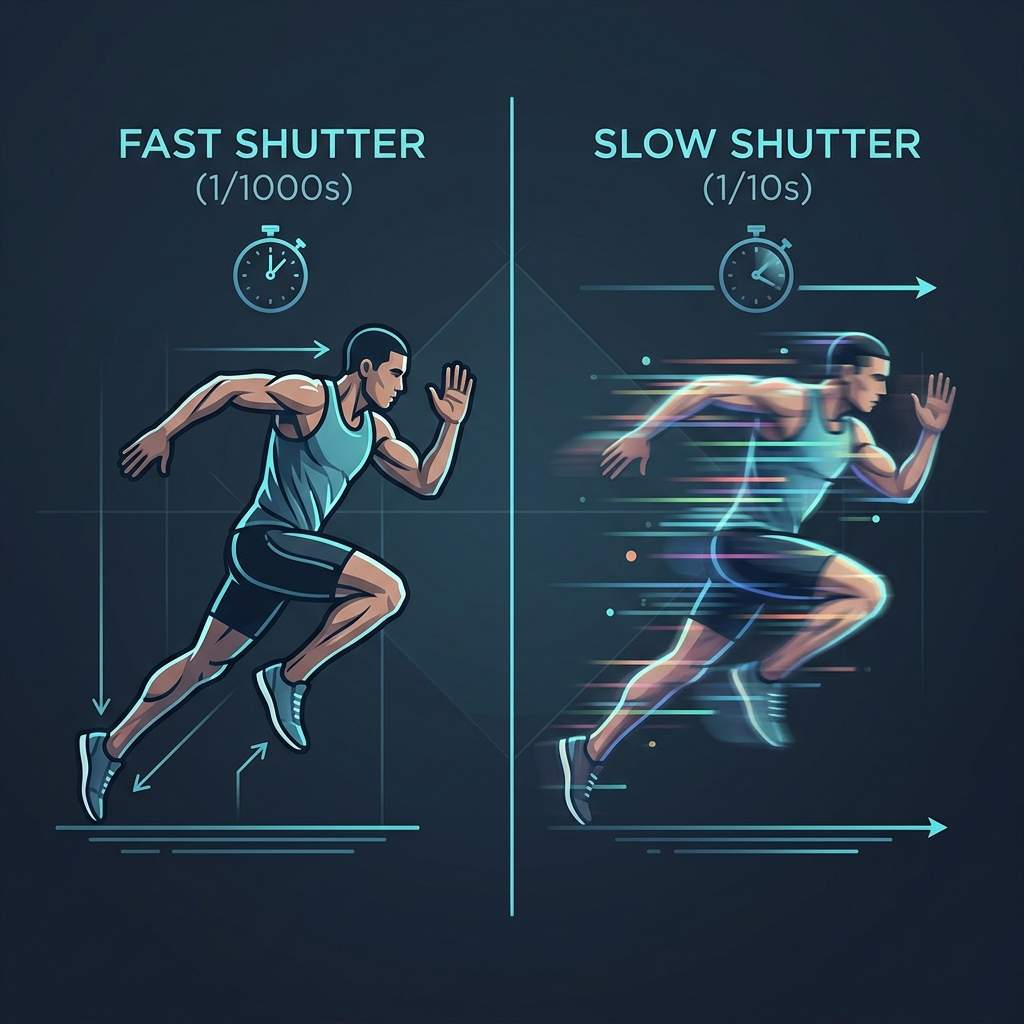
- Fast Shutter (1/1000s, 1/2000s): The eyelid opens and closes in one one-thousandth of a second! This is lightning fast. It completely freezes anything that is moving quickly. If you want to photograph a cheetah running, a basketball player dunking, or water splashing from a fountain perfectly frozen in mid-air, you must use a fast shutter speed. The trade-off? Because it blinks so fast, very little light gets in, making the picture darker.
- Medium Shutter (1/60s, 1/125s): The eyelid blinks at a normal speed. This is fast enough to take a picture of a person sitting still without your own hands shaking and making the picture blurry. This is where you will shoot most normal portraits.
- Slow Shutter (1/10s, 1s, 10s): The eyelid stays open for a very long time. Because it is open for seconds at a time, it lets in massive amounts of light, making it perfect for taking pictures of the stars at midnight. However, if anything moves while the eyelid is open, it will record as a blurry, smeared streak. You absolutely must put your camera on a heavy metal tripod when using a slow shutter, or your own breathing will ruin the photo!
Understanding shutter speed allows you to decide if you want to freeze time permanently, or stretch time out to show beautiful, flowing motion.